Home > Anti-Piracy >
When authorities in Japan shut down the world's most popular manga piracy site, that should've been a deterrent. Instead, Mangamura's demise led to an explosion of sites and even more piracy. Publishers face significant challenges but with the entertainment industries and government now on board, Japan's systematic fight against piracy applies to all content, everywhere.
After thriving in what was once a localized traditional market, Japanese comics known as ‘manga’ took the world by storm. Publishers and authors could only watch as their work fueled a huge but unlicensed black market.
By offering free localization and distribution services in what was once a chronically underserved overseas market, hobbyist translators and pirate sites made manga more accessible in every way. The problem for manga creators and publishers today is that pirates offer their copyrighted content for free in the same global market.
A new breed of highly-commercialized pirate entities, many of which seem to love money more than manga, only add to what is already a complex problem. And when Japanese rightsholders seek to mitigate infringement in overseas legal processes, new challenges appear around every corner.
In August 2022, Japanese manga publisher Shueisha filed an ex parte application at a California district court seeking information for use in a foreign proceeding – a lawsuit in Vietnam or Japan targeting pirate site operators.
Hoping to identify the operators of pirate manga sites including gokumanga.com and doki1001.com, Shueisha sought permission from a court to obtain information from U.S. companies including Cloudflare, PayPal, Visa, Mastercard, and Google.
Even at this early stage, some of the pirate sites had moved to new domains. At least one site had been targeted in a DMCA subpoena obtained a year earlier and may have switched domains around that time too.
On February 10, 2023, Shueisha teamed up with major publishers Shogakukan, Kadokawa, and Kodansha in another ex parte application (1) and proposed order (2), filed this time at a district court in Delaware.
Once again, the companies requested access to information held by U.S. internet companies to support a potential lawsuit in Vietnam or Japan.
GoDaddy and eNom customers had registered domains for two pirate manga sites, and the rightsholders were keen to receive any information that might help their investigation. Those domains – gokumanga.com and doki1001.com – were also among the targets in the ex parte application filed last August.
More than six months later, the first process is still ongoing, and according to the recent application, no pirates have been identified. The domains they used have long since been replaced, but in the past, redirected to other domains listed in the same application. It’s complex and messy, almost certainly by design. In this space, domain names may redirect, hibernate or even die, but the underlying sites prefer reincarnation.
Manga publishers, anti-piracy groups, the recording industry (RIAJ), movie and TV show companies (JIMCA and the MPA), trade organizations, tech companies players, search engines, and Japan’s government, are engaged in almost constant communication over potential anti-piracy tools and the issues they raise.
Overseas legal procedures are considered burdensome, expensive, and a strain on both time and resources, says manga publisher Shogakukan. Plans to partner with overseas entities to create a more effective international legal network could help, but that will also take time.
In the short term, rightsholders will continue to request subpoenas, hoping that information held by U.S. service providers will help them to identify pirates. At the same time, every possible enforcement idea is considered worthy of exploration.
Other options under discussion include increased liability for intermediaries and requirements for ISPs and OSPs to obtain and retain more detailed customer information. Along those same lines, the MPA and its Japanese partners have drawn attention to U.S. Executive Order 13984.
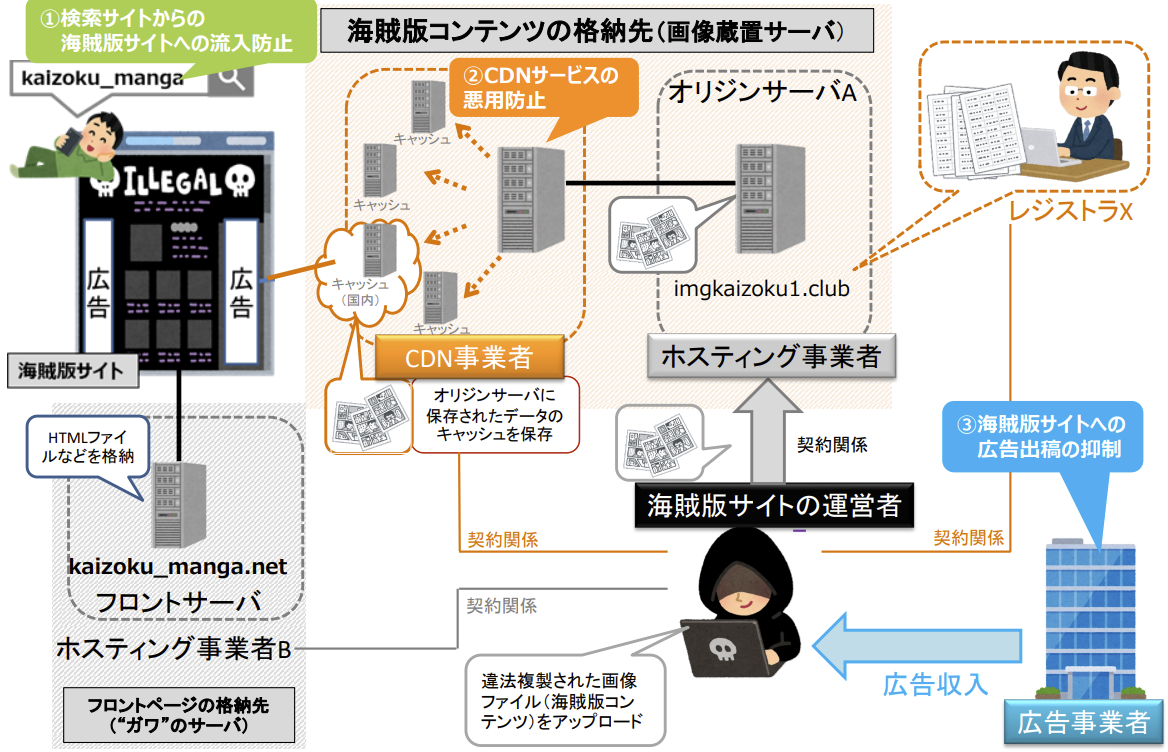
The order is supposed to deter foreign malicious cyber actors’ use of US-based Infrastructure as a Service (IaaS) platforms. Hollywood’s goal is to ensure that every domain name company, DNS provider, CDN, web hosting service, reverse proxy provider, advertising company and payment processor are bound by the same rules, so that pirates can be more easily identified.
Large international rightsholders are broadly in favor of site-blocking measures, but the topic is controversial in Japan. Proposals to restrict access to information would almost certainly face challenges under Japan’s constitution.
At least as things stand, site-blocking proposals seem to lack momentum: freedom of expression, the protection of confidentiality of communications, and the prohibition of censorship, carry significant weight in Japan. These red lines may never be overcome but more immediate issues already have universal support.
One of the most discussed issues concerns CDN providers, Cloudflare in particular. Despite various angles and mounting criticism, Cloudflare has thus far refused to give any ground. If rightsholders in Japan want content taken down, they should focus on hosting companies. These are the entities that can actually remove content; removing Cloudflare leaves infringing content online, the company says.
Suggestions that Cloudflare faces liability for pirate sites are directed to the Mon Cheri v. Cloudflare lawsuit in the U.S., from which the CDN company emerged with a clear win.
Claims that Cloudflare ‘hides’ the IP addresses of pirate sites are met with the usual response: if a site is infringing, any complaints will be forwarded to the site’s host. If personal information is required, rightsholders should present a court order.
The reasons are unknown, but discussions with Cloudflare on this topic are sometimes marked ‘undisclosed’ or confidential in reports that openly discuss other companies’ input.
In broad terms, few of those who express an opinion are happy with Cloudflare’s position. Paraphrasing comments made over the last few months, the general sentiment is that if Cloudflare has a primary goal of protecting sites from abuse on the internet, why is it the primary protector of pirate sites that are abusive in themselves?
Since Cloudflare’s position is both clear and consistent across markets, the end result is a circular argument from which there are no obvious means of escape.
Google appears to be taking the same position in Japan as it does elsewhere. If a court rules that a site is illegal and should be blocked in its entirety, Google is likely to deindex its domain so it never appears in Japan’s search results.
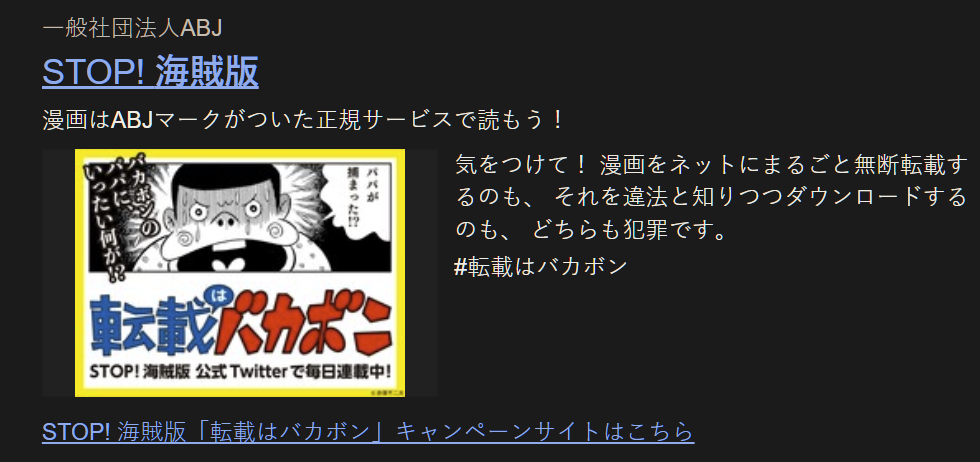
One of Yahoo! Japan’s anti-piracy contributions is more immediately visible. When users search for the term ‘海賊版’ (English: pirated version/pirate copy) Yahoo! returns an unmissable promotion for the STOP! anti-piracy campaign run by Authorized Books of Japan (ABJ) to protect manga and similar content.
Other suggestions receiving support include educational or ‘enlightenment’ campaigns to guide casual pirates back on the right track. The music industry hopes to ensure that anti-piracy education reaches Japan’s children, preferably during the early years of school.
The Japan Network Information Center (JPNIC) is Japan’s internet registry with responsibilities that include the allocation of IP addr Source: Torrent Freak